|
|
Galvanic corrosion
Fe/Zn (Evans)
|
|
Files:
Coupled corrosion (Evans).EXP
Coupled corrosion (Evans) 07.CRV

Abstract
Coupled corrosion occurs when two different materials
subject to corrosion are in contact with each other and with the
same solution. The less noble material (which is the more reactive)
will suffer from oxidation (corrosion itself) while the more noble
material will undergo a cathodic reaction (reduction process) as
predicted by the thermodynamic potentials of these materials. Coupled
corrosion is also called bimetallic corrosion or galvanic corrosion.
Evans experiments determine the corrosion current (and therefore
the corrosion rate) which is expected to take place at "rest" potential.
This rest potential is also called a mixed potential. This corrosion
current and this mixed potential are experimental values that take
into account the surfaces of the two materials. To run the experiment
properly, the more electronegative element will be the anode (zinc
for a zinc/iron system) to be used as the working electrode (WORK).
The less electronegative element will be the cathode (iron for a
zinc/iron system) to be used as the counter electrode (AUX). A reference
electrode (REF) must be used.
Sample
SolutionKCl 0.0552 M in water at room temperature
WORK Zinc (Zn plate)
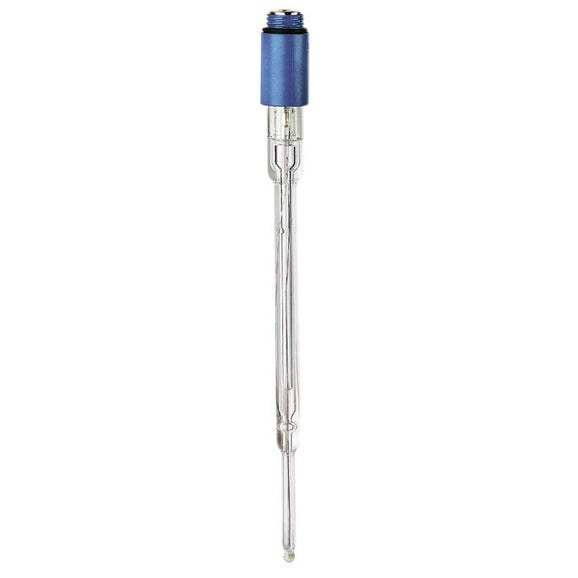
REF Calomel electrode (XR110)
AUX Iron (Fe plate)
Settings - Experimental
The current step is 1.01 µA with a current
drift of 3 mV/min and a maximum time of 30 sec.

Curve examination
1) Display:
Type = "Evans"

The WORK measured versus the REF (Potential)
is displayed and in addition the potential of the AUX measured versus
the REF (Auxiliary) is displayed in dashed lines versus the TOTAL
current.
2) Display:
Type = Normal X = Current Y1 = Potential Y2 = Auxiliary

The WORK measured versus the REF (Potential)
is displayed in Y1 and in addition the potential of the AUX measured
versus the REF (Auxiliary) is displayed in Y2 versus the current
DENSITY = current/WORK area. This is the difference with the "Evans"
display.
3) Display:
Type = Evans and estimate the corrosion rate with "Processing Evans
plot"

Evans (galvanic corrosion)--------------
30-12-1997
Working area (cm²) :0.385
Auxiliary area (cm²) :0.196
Potential : -1009.4 mV
Current : 13.561 µA
The curve can also be processed with a modification of the area
values to extrapolate the estimation of the galvanic corrosion current.
If you enter, for instance, a 1 cm² value for the working electrode
area, you obtain a slightly different estimation for the corrosion
current.
4) Display:
Type = Evans and estimate the corrosion rate with "Processing Evans
plot" with a different surface for the electrodes.

Evans (galvanic corrosion)--------------
20-01-1999, 11:14:35
Working area (cm²) :1
Auxiliary area (cm²) :0.196
Potential : -1009.2 mV
Current : 13.559 µA
Conclusion
For Zinc/Iron, the Zinc is the sacrificial anode.
The Coupled corrosion (Evans) master method plots an Evans diagram
in real time. The Evans diagram plots the potential of the two materials
as a function of the imposed current. It is possible to process
the experimental values and to modify the areas to evaluate the
corrosion current at rest potential.

|